Showing posts with label jetty fishing in Oregon. Show all posts

Thursday, May 14, 2015

Oregon Coastal Saltwater Fly Fishing Time With the Family

I was just out at the coast with my wife, mother-in-law, and father-in-law. We did a bunch of fishing along with other coastal activities. Out of the group, I am the one who fly fishes in the saltwater of Oregon, and everyone else throws spinning gear. We had all sorts of conditions ranging from calm to windy, and fishing times ranged from dead as a doornail, to moderate, to off the hook. The more I fish out there, the more I can say there is no rhyme or reason to when it will be good out there. People typically say that the two hours before high tide is the time to go. Other people say around the slack tides is the time to go. Many people say night time is the best, but I fished at night and it was good at times and sterile at times.
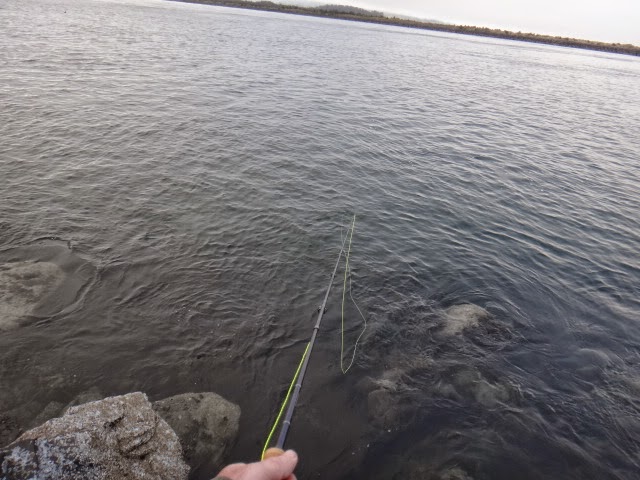
Calmer conditions are a must for successful Oregon coast fly fishing off the rocks
The one thing I see over and over again, is that it is all about the currents. Converging currents, and foam lines seem to be more about the success. The other issue is the current speeds, and by that I mean that fish are very fickle in what current speed they seem to be able to be caught in, or what current speed makes them want to bite. Whatever that part of the equation is, it seems to have correlation likely with feeding desire, and how hard the fish are working to be comfortable in their environment. Big currents and washy conditions seem to make the fishing shut down, while foam lines, and foam blankets on the surface, slow current speeds, converging currents, current breaks, and other features that provide cover, comfort, ambushing ability etc, seem to be the times when I am catching fish consistently.
A nice Pacific Black Rockfish that was on a converging current boundary
When I am out there, the conditions are ever changing and the features I just mentioned change dynamically. One moment you are fishing a foamy giant eddy, and getting fish on about every cast, and then you get a hard current pushing straight along the bank, and your line seems to be getting slacker and slacker with a subtle current pushing straight into where you are fishing from. Minutes later is settles down, and gets a soft chop slow mellow current and you are roping into a fish on every third cast for 10 minutes. It keeps on changing, and also depending on where you are standing matters too. Sometimes 50 yard to your right has a perfect setup, and you are in a fast current that feels unproductive. Walking down that 50 yards could be the difference of success for that 20 minute period, but then you may have to find another spot that fits the what you are looking for.
This Lingcod was caught near dead low tide as it was starting to slacken out.
It is ever changing as the tides are always moving higher or lower. The winds influence the currents and the tides also. Swells are another variable, and then the direction and interval of the swell also plays a big role in how the fishing pans out. The one thing I have come to realize is that you cannot tell how the fishing will be unless you simply go out try it. Only then can you know if the fish are biting. Tight lines!!!
Nice grill on this Ling
The Helios2 Saltwater 6wt is a fun lightweight rockfish rod (typically 7wt or 8wt). It also handled the Ling very nicely (lings are a 8-10wt fish).
Nikki eclipsing the sunset while casting for rockfish......
Not a bad view to check out while fishing......
Getting ready for a cast.....
These jellyfish were all over the beaches
A little kite flying time.....
A Quillback Rockfish that fell to a swim bait
Blacktail deer strolling on the beach in the early morning
A Pacific Loon patrolling for baitfish....

Thursday, February 21, 2013

FF301 - Rockfish/Lingcod Seminar


Fly fishing off of the rocks in the Pacific Northwest can be very exciting, and it is a totally untapped fishery for the fly fisher seeking out an alternative to the standard trout/steelhead/salmon game. You can hook fish after fish at times, and you will often be the only person out there. Some locations offer fishing where you have no idea what fish may bite your fly next. It may be a Black Rockfish, a Quillback Rockfish, a Lingcod, etc...

Checking out a Black Rockfish caught off of a jetty
You may be wondering how do I even start to target any of those fish on my fly rod? Well this FF301 is designed to show you how to fly fish for "bottom fish" in the Pacific Northwest. It is a class, and not a guided fishing trip; so make sure before you sign up that you understand that we are not going on a guided fishing trip in the saltwater. This will be a class with 5 students, and we will be out there in waders learning how to bottom fish on our own for future outings. We will be learning how to fish for these rockfish and lingcod with our fly rods, and catching them will only be a byproduct of the demonstrations, and people learning the techniques properly. We will be fishing a lot in the class, and fish should be caught, but the point of this class is to be able to target these fish species with the right fly lines, flies, and techniques all on your own.
 -My goal is to have the class participants to be able to tell me how they are successfully catching "bottom fish" on their own after they have taken the class.

Date:  Saturday March 16th  (alternate date Saturday April 6th 7:30am-12pm - If really severe weather strikes for original scheduled date)

Time:  2:15pm-6:45pm

Location: Tillamook Bay area or Netarts Bay area (to be determined according to conditions when class date arrives) - Both are similar in driving time.

Cost:   $75 per person - 5 people will be in the class

Equipment Needed:
The Basics:  Waders and Sturdy wading shoes with studs, polarized sunglasses, raingear for the elements, Oregon fishing License
Rod/Reel: A saltwater 7wt at the minimum all the way to a 10wt saltwater rod will work with a saltwater reel to match the rod. Fly lines for the class and future rockfishing trips are specialized shooting heads; so inquire about what you will need if you are serious about taking the class, and plan on doing saltwater rockfishing in the future. The same fly lines can be used for tidewater salmon fly fishing; so there are more uses for the shooting heads than just rockfish and lingcod.
-I do have some extra gear; so inquire if you are interested but lack the rod/reel to take the class. Switch rods will work for this fishing too. Ask again if you are interested, and have equipment questions. 
Flies:  The class will include several flies per person, but you may also want to pick up some flies for your own experimentation as well. If you are interested in tying up some flies for the class, or buying any to try out, then email me, and I can provide a list of some options to try out.


If you are interested in taking the class; email me at fish@mckenzieangler.com or call (541)-232-6360. 

A nice hefty Black Rockfish caught on the first cast of the day.....

Thursday, June 7, 2012

Rockfishing - Fly Anglers Can Offer Sound Advice to Conventional Anglers

This past Tuesday, I went to the coast to attempt some jetty fly fishing. I was out to target both pacific rockfish and lingcod. The day ended up being pretty nice; considering that it was supposed to be raining hard and semi windy over there. Instead it was relatively calm in regards to the winds, and the weather was between sunny and showers. The showers were short lived and the sunshine was warm and pleasant. The fishing was so so, and by that I mean that at times I was catching them on every cast, and at times I went a while between a grab. All in all it was a pleasant day of fishing, and it was worth the trip. It was especially fun having several guys conventionally fishing asking me what I was doing and what I was using. They saw me catching fish more consistently than anyone else out there; so they were prying me for information. That was a good feeling to have the fly guy being the source of how to get into the rockfish while fishing the jetty. Especially the fly guy from the city giving passing on information on how to be a more successful salty dog!


Thursday, May 3, 2012

Oregon Coast Fly Fishing 5/3/2012

 Yesterday, I headed to the coast for some different fly fishing than the norm for your typical Oregonian. Although what is "normal" fly fishing anyway? I know I love my carp fly fishing, and now that is almost considered "normal", but not quite yet.....

I was going for bottom fishing for species like rockfish, cabezon, and lingcod, and hopefully the conditions would produce some fish. The first spot I hit was Netarts Bay, and I was trying off of the rocks for a good while before I decided that the tidal movement felt too intense to get a decent presentation to actually catch a fish. On the walk back to my car, I decided to wade out into a sandy flat to literally just bomb out a few casts. It was not really something that I actually was thinking would produce a fish, and I wanted to more or less cast out a few huge bombs just for fun and casting practice. It turned out that on the second cast, when I was stripping my huge two tailed conehead saltwater white bunny leech (for Rockfish, Cabezon, & Lingcod), I got a crushing take. The line had a fast hard radical pull, and I wondered what I had on. It was no bottom fish, nor was it a surf perch (which I knew swam in the exact area), and it was fast and pulling hard; swimming like a salmonid. The glimpses I had of the fish seemed to be anything from a steelhead, a huge sea run cutt, or a salmon. Finally the fish tired enough to reveal that it was a salmon in its saltwater oceanic part of its life cycle. It was so chrome bright, where it was practically transparent, and had a holographic shimmer to it fins. It was humbling; since it made me realize how random things in fishing happen even when you think you have a grasp on what is going on. Surprises happen, and that is another reason why we fish!
While casting into a large sandy saltwater flat, this salmon intercepted this Rockfish fly
After that, I drove to the Tillamook Bay in hopes of better bottom fishing, and the tide was drawing to a near slack "low" time. The currents would not be as fast near the slack tide; so I figured I would be able to get a better presentation to the fish I was targeting. It turns out that I made the right decision, as the fishing was consistent and action packed for about 2 hours. I was throwing a shooting head system with an intermediate sinking running line with a type II 28 foot sinking shooting head. The leader was a short hand tied three piece configuration of 18 inches of 30# butt section to 9 inches of 25# to 2 feet of 20# tippet. The flies I used were both 2/0 in hook size, and one was a synthetic clouser with chartruese and white; while the other was a conehead two tailed white bunny leech.  
This black rockfish took this large two tailed white conehead bunny leech
All in all it was a fun day of fishing between the incidental salmon and the rockfish I got into. I also briefly hook up with a larger fish that was either a cabezon or a lingcod, but it was a short lived hookup. I did see the fish eat my fly and had it on long enough to bend the rod over hard. Just then, it was off....

Fly fishing for bottom fish off of jetties in Oregon requires a shooting head line system
  Once the tide turned around and started to slowing become "incoming", the fishing seemed to shut off like a light switch. How strange; since the reputation is better for good fishing at incoming tide. Who knows.... that is why we call it fishing and not catching I guess....

Below is a short video of some of the action from the day. I was not filming too much; so I missed the best fish, and it seemed like when I was filming it was jinxing the action. Nonetheless, you can see what some of the fishing was like out in the inshore Oregon saltwater.....